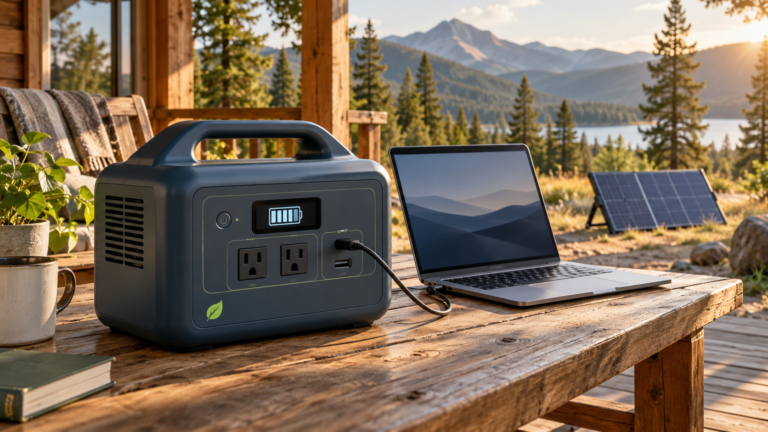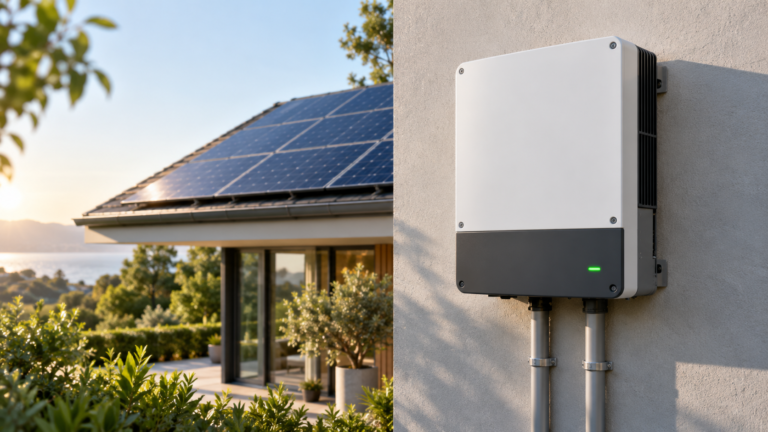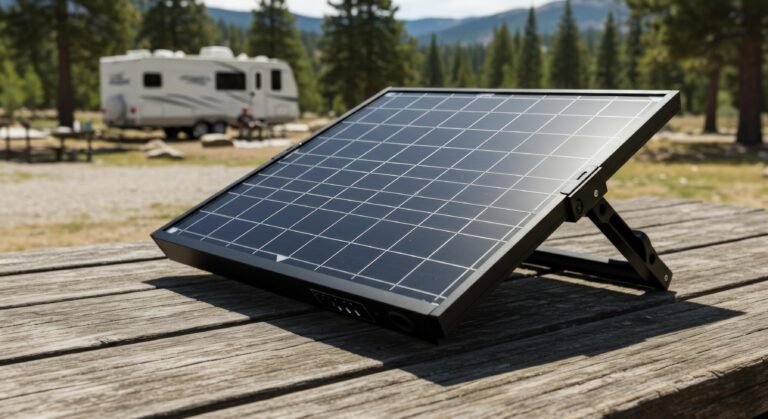

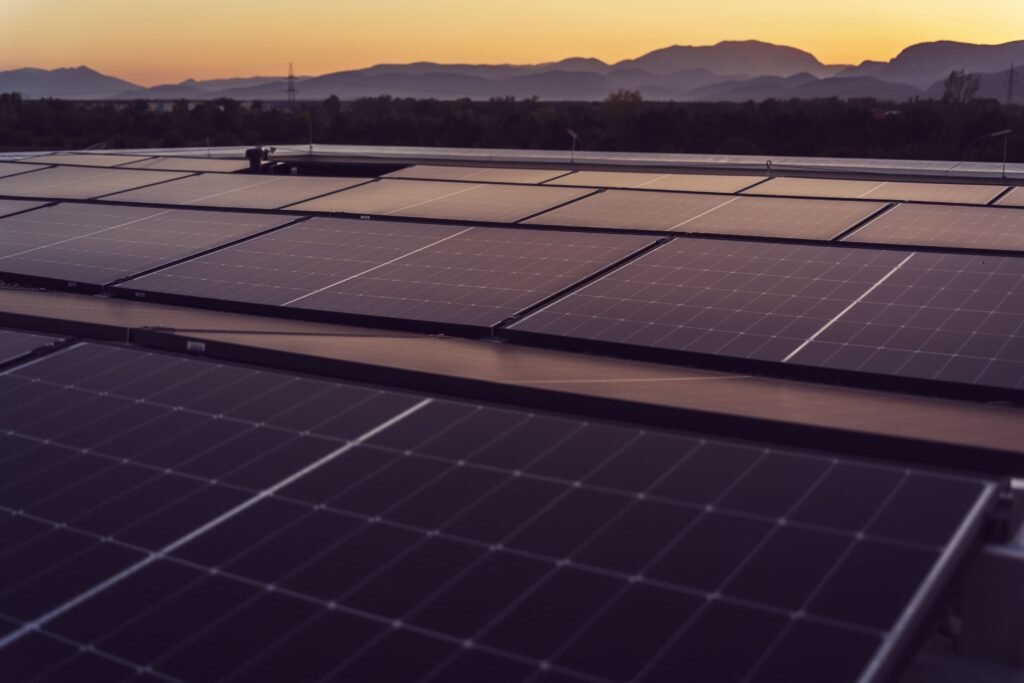
Sunlight can charge a phone at a campsite, help power a home, or supply electricity to the grid. These setups differ in size and equipment, but they begin with the same process: solar cells converting light into electricity.
That sounds straightforward until you start comparing panels. What does a watt rating actually tell you? Why does output drop on a hot afternoon? And how does electricity from a panel become something your devices can use?
This guide follows that journey from sunlight to usable power. Along the way, we’ll explain the measurements on a panel’s label, the conditions that affect production, and the role of the equipment connected to it. You don’t need an engineering background, just a clear picture of how the pieces work together.
What is solar energy?
Solar energy is energy from the sun, which reaches us as light and warmth. Solar technologies can capture that energy in different ways. This guide focuses on photovoltaic, or PV, panels, which convert light directly into electricity.
A PV panel generates electricity without moving parts or burning fuel. It does not store the energy it produces. That electricity must be used as it is generated, stored in a battery, or sent somewhere else, such as the utility grid through a suitable system.
To understand how that happens, start with the smallest electricity-producing part of a panel: the solar cell.
How does sunlight become electricity?
The process begins inside a solar cell, the electricity-producing building block of a panel.
Solar cells are made from semiconductor material that contains electrons. When sunlight hits the cell, tiny packets of light called photons give some of those electrons enough energy to move. Think of it as sunlight giving the electrons a nudge. An electric field inside the cell helps direct their movement, and when a circuit is connected, they flow through it as an electric current that can power devices.
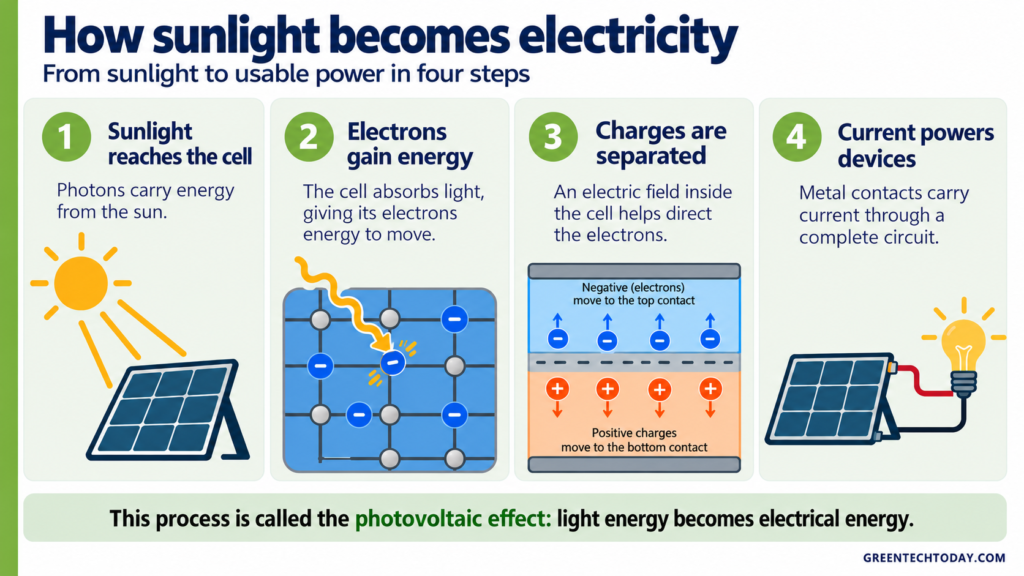
This process is called the photovoltaic effect. Think of sunlight as providing the energy that gets things moving, while the solar cell’s structure helps turn that movement into useful electrical output.
A panel in sunlight can have voltage even when nothing is connected. Current flows through an external circuit only when there is a complete path. That distinction becomes useful when we look at the numbers on a panel’s label.
How do cells, panels, and arrays fit together?
One cell produces a small amount of power. Connecting cells and solar panels, also often referred to as modules, together allows that output to scale up.
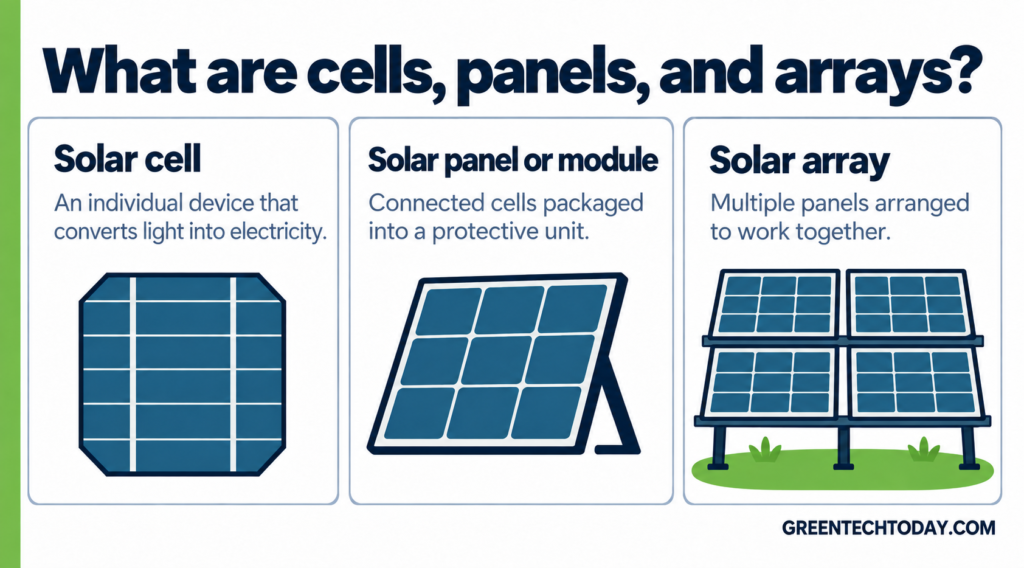
Whether you have one portable panel or a rooftop array, the cells produce the same basic kind of electricity.
What kind of electricity do solar panels produce?
Solar cells produce direct current (DC) electricity, in which current flows in one direction. Batteries, electric vehicles, and everyday electronics like smartphones and computers are powered by DC electricity.
Household outlets supply alternating current (AC), in which current repeatedly changes direction. Lights, air conditioning, and most anything you plug in at home will run on AC electricity.
An inverter is used to convert DC into AC so that power generated by a solar system can be used to power devices designed to use household power. The route from panel to device therefore depends on the equipment involved. Before following that route, it helps to understand how electrical output is measured.
Understanding volts, amps, watts, and watt-hours
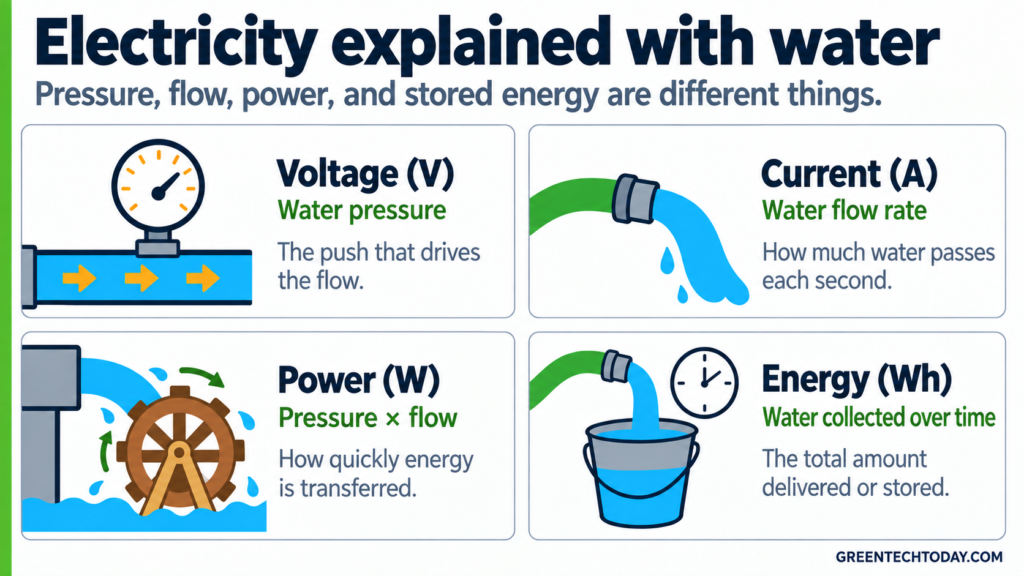
Water flowing through a pipe offers a surprisingly useful analogy. Picture water flowing through a pipe to turn a water wheel. The water pressure, the amount flowing, and how long the wheel runs offer a useful way to understand these four electrical measurements.
Volts: the electrical push
Voltage, measured in volts (V), is like water pressure. It provides the electrical push that helps move charge through a circuit.
A pipe can hold pressure with the tap closed. Similarly, a sunlit panel can have voltage without supplying current. A device that can accept the voltage of the solar panel needs to be connected to open the tap.
Amps: the flow of charge
Current, measured in amps (A), describes how much electrical charge flows each second. In the water analogy, this is the amount of water passing through a pipe each second. More amps means more electrical charge flowing each second.
Think of the difference between a trickle and a steady stream. Both involve flowing water, but the stream carries more water over the same amount of time.
Voltage and current work together to determine electrical power.
Watts: power at a particular moment
Power, measured in watts (W), describes the rate at which electrical energy is delivered or used. Water flowing through a wheel can make it turn and do work. The power available depends on both the pressure driving the water and the amount flowing.
For DC electricity:
Volts × amps = watts
A panel operating at 20 volts and delivering 5 amps supplies:
20 V × 5 A = 100 W
That is the power being delivered at that moment. Just as a change in water flow affects the wheel’s power, a passing cloud can change a solar panel’s output.
Watt-hours: energy over time
Energy, measured in watt-hours (Wh), accounts for both power and time. Imagine running the water wheel at a steady power for one hour. Running it for two hours delivers twice as much energy.
Average watts × hours = watt-hours
A device drawing 50 watts for two hours uses 100 Wh. A panel averaging 100 watts for three hours produces 300 Wh.
When dealing with greater amounts of energy, you will also see larger units of measurement:
1 megawatt-hour (MWh) = 1,000,000 watt-hours
1 kilowatt (kW) = 1,000 watts
1 kilowatt-hour (kWh) = 1,000 watt-hours
1 megawatt (MW) = 1,000,000 watts
The practical distinction is simple: watts tell you how much power is available or being used, while watt-hours tell you how much energy is produced, consumed, or stored.
What does a solar panel’s watt rating mean?
Now that watts have a clear meaning, a panel’s advertised rating is easier to interpret. A 200-watt panel is rated to produce around 200 watts under a specified set of test conditions. It does not produce that amount continuously.
Most advertised ratings use Standard Test Conditions (STC): sunlight intensity of 1,000 watts per square meter, a cell temperature of 25°C (77°F), and a standardized sunlight spectrum. These conditions provide a consistent basis for comparing panels.
Some panels also include Nominal Operating Cell Temperature (NOCT) information. This describes cell temperature under another defined set of conditions, including weaker sunlight, air temperature of20°C (68°F), and a light breeze. Power figures listed for these conditions are generally lower than STC ratings.
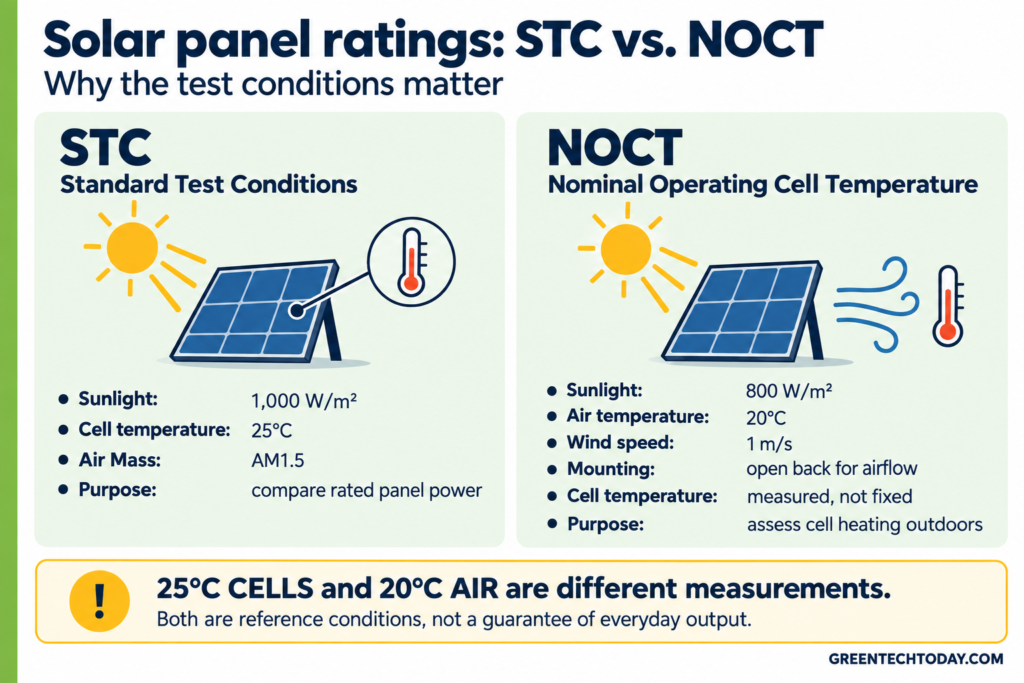
The important detail is that cell temperature and air temperature are different. A panel sitting in the sun can become much warmer than the air around it. Ratings are reference points, while actual output depends on the conditions where you use the panel.
What does solar panel efficiency mean?
Efficiency describes the how much incoming sunlight a panel converts into electrical power. If 1,000 watts of sunlight falls on a panel and it produces 200 watts of electricity, its efficiency under those conditions is 20%.
Higher efficiency is especially helpful when space is limited. A more efficient panel can produce the same rated power using less surface area, although efficiency alone does not tell you everything about real-world performance as there are a number of factors that can cause a solar panels output to increase or decrease.
Why does solar output change?
A panel’s rating stays the same, but its operating conditions change throughout the day. Several factors explain why the reading on your display may rise and fall.
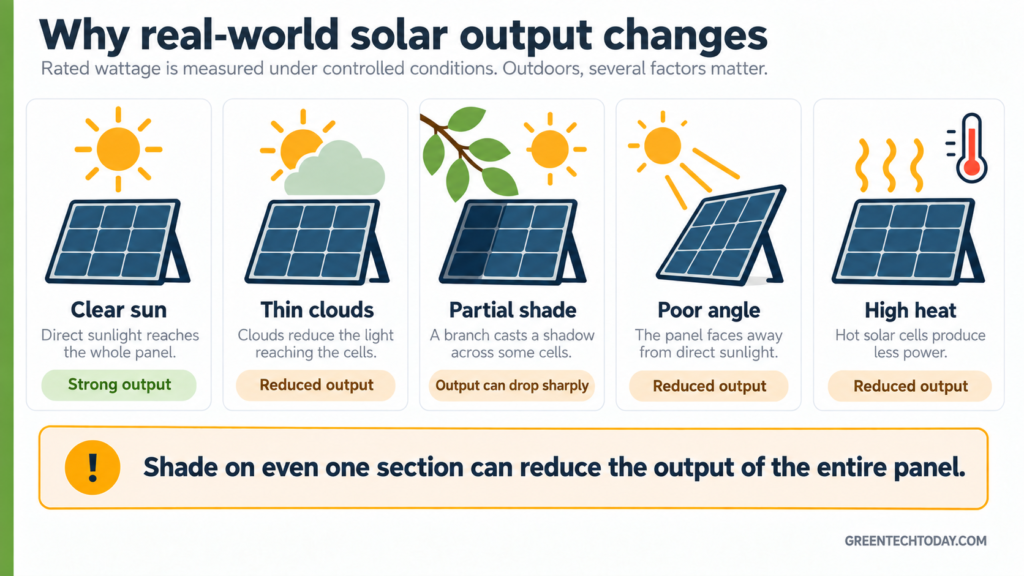
Sunlight intensity and cloud cover
Stronger sunlight generally makes more power available. Time of day, haze, and cloud cover will reduce the sunlight reaching the cells. A bright-looking morning sky is not necessarily delivering the same solar intensity as clear midday sunshine.
Panel direction and angle
A panel generally captures more direct sunlight when its surface faces the sun more directly. As the sun moves across the sky and changes position with the seasons, the light reaching a stationary panel changes too.
Shade and surface obstructions
Shade reduces the light available to the solar cells. Because solar cells are wired as a series circuit, meaning the electric current must flow through every single cell in a chain, the resulting power loss can be greater than the shaded area alone might suggest.
Going back to the water metaphor from before, if there is a clog in one section of a pipe, the overall flow of water drops for the entire length of pipe.
Cell temperature
Panels use light to generate electricity, but they also absorb heat. For most common PV panels, cell temperatures above 25°C (77°F) reduce voltage and overall power when other conditions remain the same.
This is why a cool, clear day can provide excellent production conditions. Hotter weather does not automatically mean more solar power.
Nighttime
Ordinary solar panels do not produce useful power after dark. Moonlight is too weak to provide meaningful output for typical applications.
A solar-powered device that continues operating at night is using another energy source, commonly a battery charged from sunlight earlier in the day. That brings us to what happens after electricity leaves the panel.
Where does the electricity go?
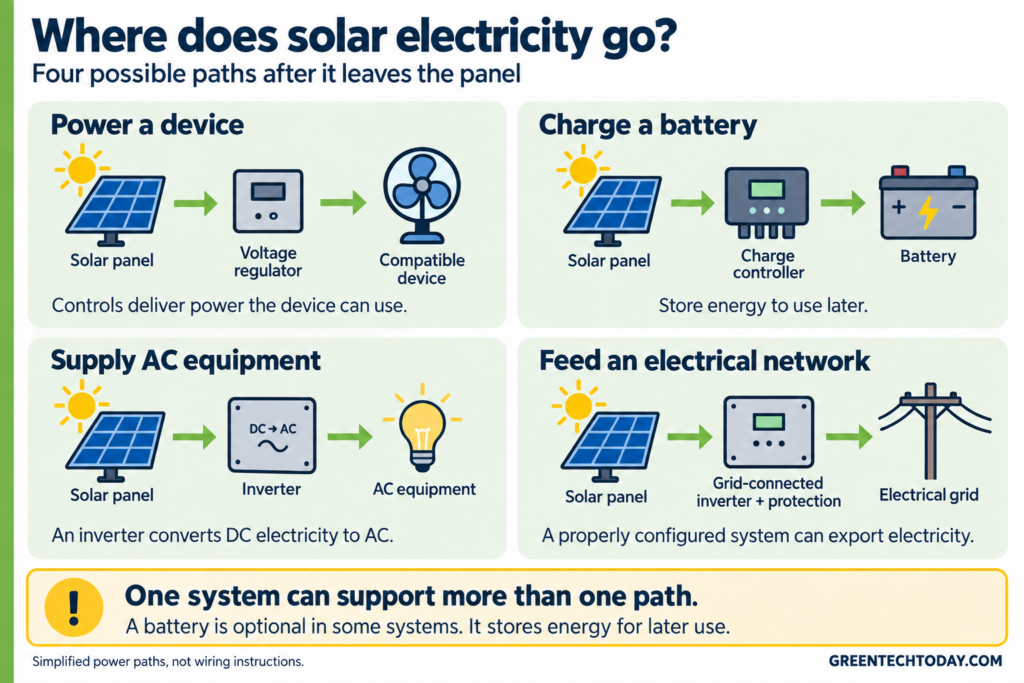
The connected equipment manages the panel’s output for its intended use. Depending on the system, electricity may:
- Supply compatible DC devices through a suitable voltage regulator.
- Charge a battery through a suitable charge controller.
- Pass through an inverter to power AC equipment.
- Supply a home or feed the utility grid through an appropriately designed system.
Be aware that some systems support more than one of these paths. It comes down to the operating limits of the individual components that make up a solar system. These limits help explain why available sunlight and the power generation shown on a solar energy monitor do not always seem to match.
Why might a solar monitor show less than expected?
A solar energy monitor is a device that reports a measurement at a particular point in the system. It might show solar input power, battery charging power, appliance consumption, or accumulated energy. Check the label and units before comparing readings.
The power accepted by a solar system is not always equal to the amount generated. All electrical equipment have safe operating limits (SOL). Similar to how a dam controls the amount of water it allows downstream, you connected equipment may limit the amount of power it takes in. Energy going to a battery might be reduced as it gets close to full or less power is needed because the devices connected need less.
Different displays may also measure different points in the system. Power measured at the panel input will not necessarily match power measured after conversion or battery charging.
When comparing readings, ask two questions:
- Where is this measurement being taken?
- What is the system doing at that moment?
A lower number may reflect changing sunlight, conversion losses, or normal control behavior. It does not automatically indicate a faulty panel.
How can you estimate energy production?
Start with average power over a known period.
Suppose a panel averages 150 watts over four hours:
150 W × 4 hours = 600 Wh
That is 0.6 kilowatt-hours of energy produced during that period of time. The difficult part is predicting the average power. Multiplying a panel’s rated wattage by the number of daylight hours usually overestimates production because sunlight is not equally strong all day.
For planning, see our guide on how to size a solar system.
What should you look for on a solar panel label?
You do not need to memorize every abbreviation. Start by identifying what each number describes.
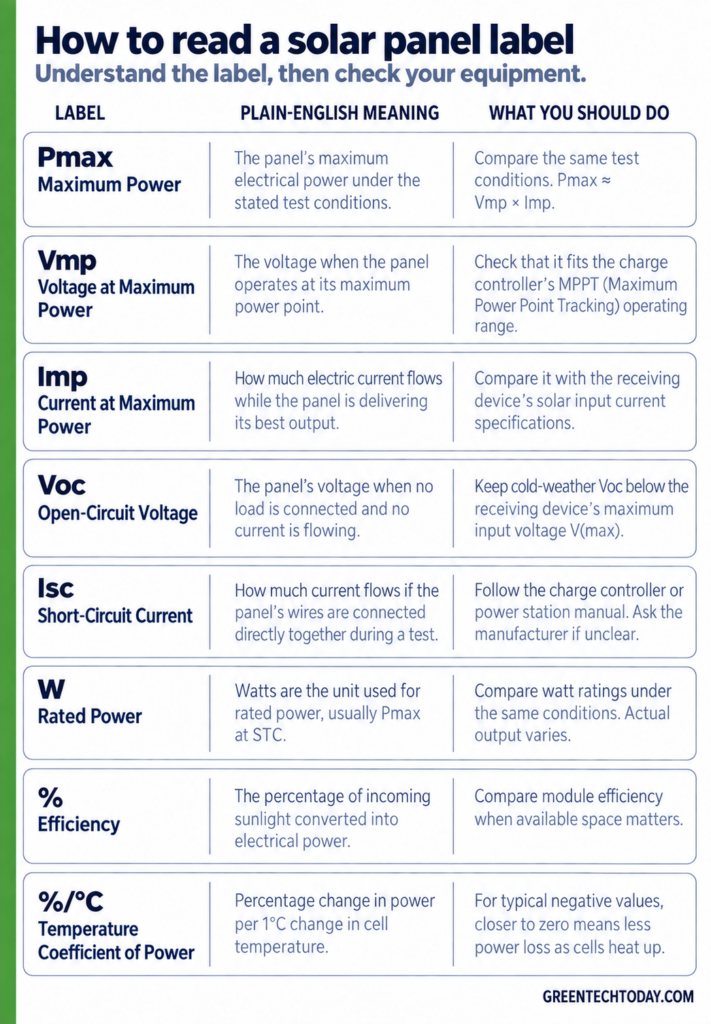
These figures describe different operating conditions. For example, you cannot multiply open-circuit voltage by short-circuit current to find usable panel power because those values do not occur together. When operating at the maximum power point, Vmp × Imp approximately equals the rated power, allowing for rounding.
Once these terms become familiar, a panel label becomes much easier to read. You can distinguish what the panel is rated to produce, what the connected equipment must accommodate, and why the numbers you see during use change with the conditions.
Putting the pieces together
Solar power becomes easier to understand when you follow the whole journey: cells convert light into DC electricity, connected equipment manages that output, and devices use the energy or batteries store it for later. Panel ratings provide a comparison point, while sunlight, temperature, placement, and system limits determine what you actually get. With watts and watt-hours clearly separated, you can read specifications with more confidence and build realistic expectations for a small portable setup or a larger home system.