
You have a few devices to charge, a trip coming up, and a choice of solar panels that all promise useful power outdoors. Is 100 watts enough? Would 200 watts be safer? And does a bigger battery mean you need a bigger panel?
The easiest place to start is with what you actually use each day. Once you know that, you can work out how much sunlight you need to replace it. You do not need a perfect prediction, just a realistic estimate with some wiggle room.
First, separate panel power from battery capacity
It is easy to compare the biggest numbers on two product pages and assume they should match. They usually describe different things.
| Specification | What it tells you |
|---|---|
| Panel wattage, such as 200 W | The panel’s rated power under standardized test conditions. Outdoor output varies. |
| Battery capacity, such as 1,000 Wh | The battery’s nominal energy storage. The actual usable amount is based on real-world conditions. |
| Power station output, such as 1,000 W | How much power the station can supply to devices at once, subject to its specifications. |
| Solar input limit, such as 200 W | The power station’s maximum solar charging power, alongside separate voltage and current requirements. |
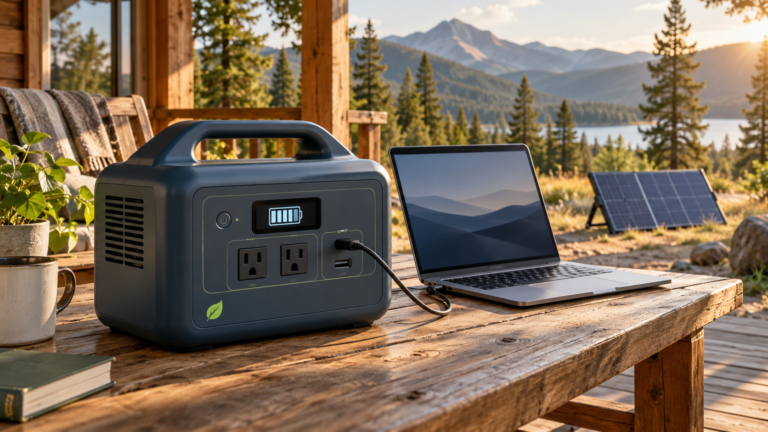
A power station with a 1,000 Wh battery does not automatically need a 1,000 W solar panel. Nor should you assume that a 100 W solar panel won’t produce enough energy to charge your 200 Wh laptop.
Think of the battery as a water tank. Its size tells you how much it holds. The panel helps determine how quickly you can refill it.
Step 1: Add up your daily energy use
Start with a short list of everything you expect to power. Include the obvious equipment, such as a refrigerator or laptop, along with lights, fans, phones, and camera batteries.
For a device drawing fairly constant power:
Watts × hours of use = watt-hours
A 10 W light running for five hours uses 50 Wh. A laptop averaging 60 W for three hours uses 180 Wh.
Here is an illustrative camping setup. Your equipment may use substantially more or less.
| Device | Assumed daily use | Energy used |
|---|---|---|
| Portable refrigerator | 40 W while running, 10 total running hours | 400 Wh |
| Laptop | 60 W average for 3 hours | 180 Wh |
| Lights | 10 W for 5 hours | 50 Wh |
| Phones and other small devices | Combined estimate | 170 Wh |
| Daily total | 800 Wh |
A piece of equipment like the refrigerator needs a little explanation. It has a compressor that switches on and off, so ten running hours could be spread across a full 24 hour period. Temperature, settings, and how often you open it affect consumption. Measuring a full day’s energy use is more useful than determining how much energy it uses during a specific hour.
A laptop charger can also be misleading. A 60 W rating does not mean the laptop continuously uses 60 W. That is only telling us the maximum power capacity it can deliver or handle, not the constant amount it uses.
Even with these caveats in mind, use the listed rating when determining your solar panel size so you don’t end up in a situation where your energy needs can’t be met.
No measurements yet? Start with clearly labeled estimates and refine them later. Even a rough device list is more useful than choosing a panel by guesswork.
Step 2: Estimate the sunlight you can actually use
Eight hours of daylight does not mean eight hours of full solar output. Morning light, late-afternoon light, and midday sun contribute different amounts of energy.
A peak-sun hour is an hour where the energy from sunlight at 1,000 watts per square meter. A full day’s sunlight might only contian four peak-sun hours even though daylight lasts much longer.
Use a solar-resource estimate for your destination and the month of your trip. An annual average can hide seasonal differences. Location, weather, and the surrounding landscape also matter.
Then consider your routine. Will the panel sit in an open area all day, or will you unpack it after a morning drive? A full-day sunlight estimate will overstate your production if you miss much of that day’s sun.
For the calculations here, we will assume four usable peak-sun hours per day. Treat that as an example, not a default for every campsite.
Step 3: Account for losses and calculate your panel size
A panel’s rated wattage is measured under standardized laboratory conditions. In the real world, heat, positioning, cables, battery losses, and power conversion affect how much energy reaches your devices.
This guide uses a 70% overall energy allowance to simplify those effects. This is different from solar-cell efficiency. Difficult conditions can produce results below this estimate.
For our 800 Wh camping setup:
800 Wh ÷ (4 peak-sun hours × 0.70) = approximately 286 W
That makes a 300 W setup the mathematical starting point. With the same assumptions, it supplies about 840 Wh per day, leaving very little extra beyond the baseline 800 Wh requirement.
Considering a 350 W or 400 W will provide more room for variation. That extra capacity is useful when the laptop stays open longer or sunlight falls short. However, even a larger solar panel can’t guarantee enough energy through prolonged poor weather.
If you already account for charging, battery, and inverter losses individually, you don’t need to apply the 70% allowance again. That would double count the delivery losses and give you an inaccurate estimate.
What can common panel sizes produce?
The table below uses the 70% allowance. These are calculated daily energy estimates available to devices, not measured product results.
| Rated panel capacity | 2 peak-sun hours | 4 peak-sun hours | 6 peak-sun hours |
|---|---|---|---|
| 50 W | 70 Wh | 140 Wh | 210 Wh |
| 100 W | 140 Wh | 280 Wh | 420 Wh |
| 200 W | 280 Wh | 560 Wh | 840 Wh |
| 300 W | 420 Wh | 840 Wh | 1,260 Wh |
| 400 W | 560 Wh | 1,120 Wh | 1,680 Wh |
These estimates assume your equipment can accept the panel’s output and that battery storage or active loads can use the energy as it arrives. Be sure to confirm this with whatever complete system you build.
Look at the 200 W row. Four peak-sun hours gives an estimated 560 Wh, while two gives 280 Wh. The same panel can suit your needs in one situation and leave you short in another.
This is why asking what a panel can power works best when you also ask where, when, and for how long.
Step 4: Check your power station before buying
Once you have a target wattage, check the specifications labeled solar input, PV input, or DC input in your power station’s manual.
Confirm these requirements:
- Allowed operating voltage and maximum input voltage.
- Input current limits and connection rules.
- Permitted panel or array wattage.
- Connector type and polarity.
A power station with a 200 W solar charging limit cannot accept 400 W at once. Some manufacturers allow extra panel wattage within specified electrical limits, which can help in weaker sunlight. Others restrict the connected array size.
A matching plug does not confirm compatibility. Follow the manufacturer’s requirements for the complete panel setup. Our Complete Guide to Portable Solar Panels explains the compatibility checks in more detail.
Step 5: Give your battery a separate job
Your panel collects energy when conditions allow. Your battery keeps things running when energy collection stops.
If your devices use 800 Wh per day, two days without useful solar charging requires about 1,600 Wh of usable energy. The battery’s advertised capacity needs to be higher to account for its usable range and delivery losses.
There is also the day after poor weather to consider. A solar panel that barely replaces today’s consumption has little spare production to refill yesterdays deficit. In order to build a battery reserve back up you’ll need extra generation, reduced consumption, another charging source, or more simply time.
For a short trip, your goal may be simpler. Starting with a full battery and using solar to extend its runtime can require less panel capacity than replacing all your energy use indefinitely.
Common questions
Is a 100 W panel enough for camping?
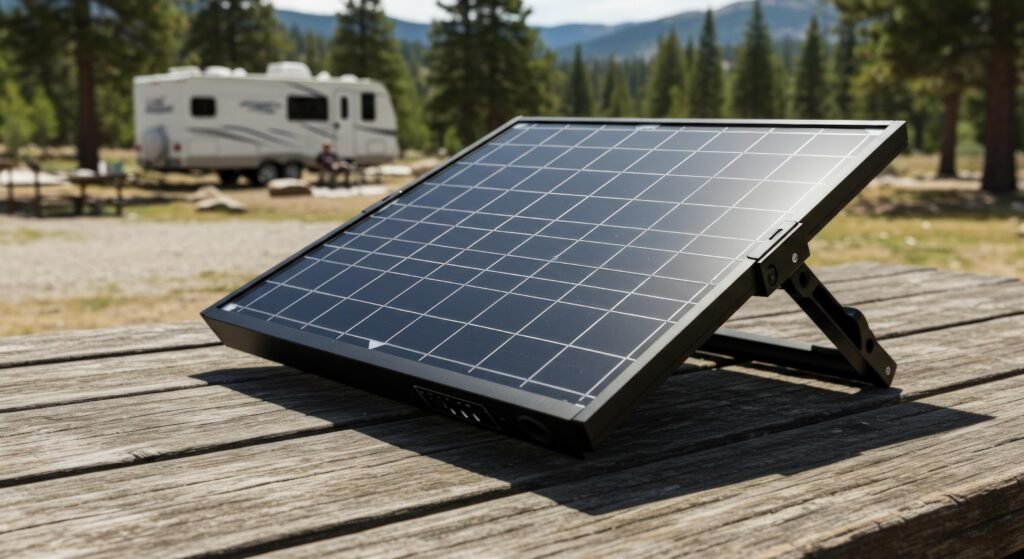
It can suit a low-energy setup. With four peak-sun hours and this guide’s allowance, it supplies an estimated 280 Wh per day. Compare that with your device total, especially before adding refrigeration or several hours of laptop use.
What size panel do I need for a 1,000 Wh power station?
Start with how much energy you need to put back. Replacing a small amount after light use takes less production than recharging a nearly empty battery. Your available sunlight and the station’s solar input limits determine the practical panel size.
Will a larger panel let me run a more powerful appliance?
The power station’s output and surge ratings determine whether it can operate the appliance. More solar capacity helps replace the energy used, but it does not increase those output ratings.
Should I choose the biggest panel I can carry?
Check whether you need the additional production and can use it. Folded dimensions, weight, and setup space matter too. A panel that fits your routine is more useful than one you regularly leave packed away.
Choose a size that fits your actual day
Add up your daily watt-hours, estimate the sunlight available during your charging window, and allow for losses. Then check compatibility and decide how much reserve you want.
For our 800 Wh example, roughly 300 W is the starting point with four peak-sun hours. A compatible 350 W or 400 W setup adds room for variation.
You do not need to predict every cloudy afternoon. You do need a setup that reflects how you travel, what you power, and how often you can recharge another way.