
Why do you need an inverter?
Electricity comes in different forms, and your equipment needs the form it was designed to accept.
Direct current, or DC, flows in one direction. Alternating current, or AC, reverses direction repeatedly. Solar panels and batteries work with DC, while household outlets supply AC.
That difference explains why a solar panel cannot simply replace a wall outlet. Between the DC source and an AC appliance, you need equipment that converts the electricity and provides the correct output.
An inverter performs that conversion using electronic switches and control circuitry. In a system connected to the utility grid, it also coordinates its AC output with the grid.
You do not need to understand the circuitry to understand its role. If your energy source supplies DC and your appliance requires AC, an inverter belongs somewhere in the system.
Where does an inverter fit in a solar system?
The location depends on how you use solar power.
Rooftop solar
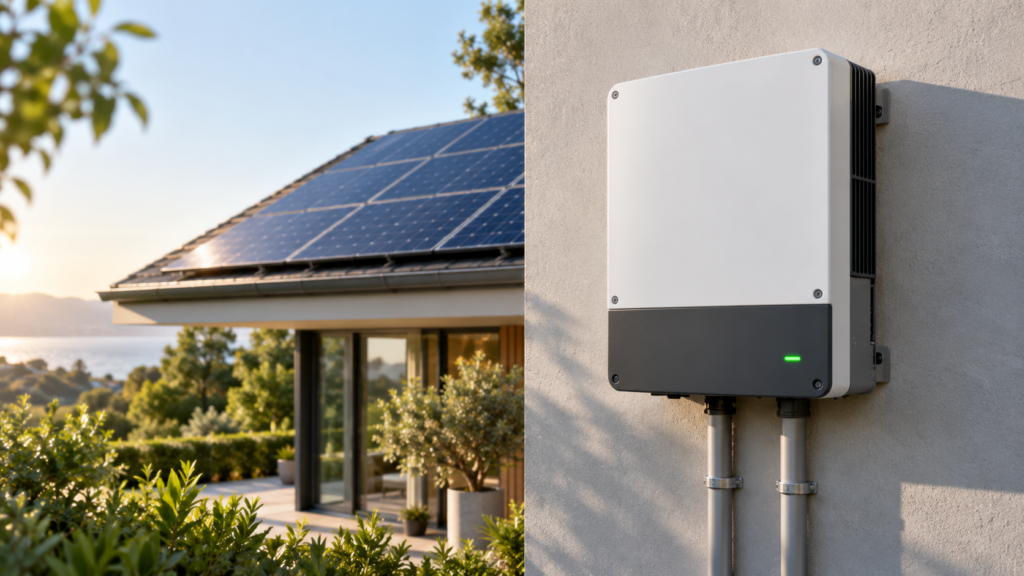
In a basic grid-connected rooftop system, solar panels produce DC electricity. The solar inverter converts it into AC for your home’s electrical system. Depending on the installation and utility arrangement, surplus electricity may flow to the grid.
A battery backup is optional for this basic arrangement. The inverter can convert solar electricity while the panels are actively producing it.
A battery backup, camper, or separate-component system
In a typical battery-based setup, panels charge a battery through a solar charge controller, which regulates charging. A battery inverter draws DC electricity from the battery and supplies AC to connected appliances.
Here, the inverter lets you use stored energy after sunset. The battery supplies the energy, and the inverter makes it usable by AC equipment.
A portable power station
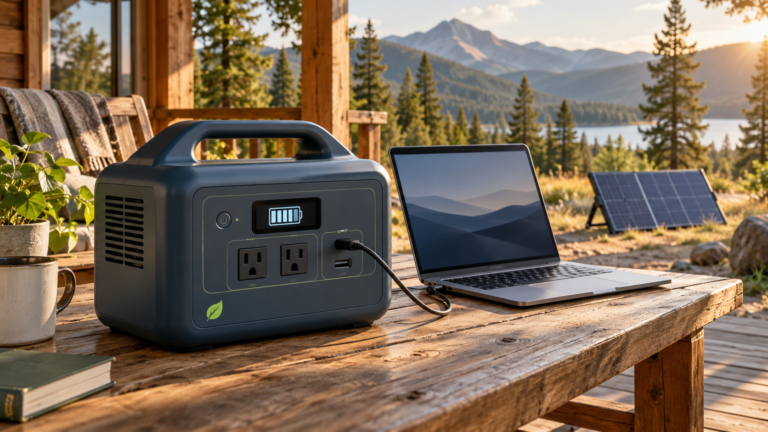
A portable power station with AC outlets already contains an inverter. It shares the enclosure with the battery and charging electronics, so you usually do not need to buy a separate one.
When you switch on its AC outlets, you are enabling that conversion. Its USB and other DC outputs generally use separate DC conversion circuitry.
What are the main inverter types?
Inverter names can be confusing because they describe different things. Some describe where conversion happens. Others describe whether the equipment works with batteries or the grid.
| Type | What it does | Where you might encounter it |
|---|---|---|
| String inverter | Converts DC from groups of connected solar panels into AC at a central unit | Rooftop solar installations |
| Microinverter | Converts solar DC into AC at individual panels, though some models serve multiple panels | Rooftop solar with shading issues |
| Battery inverter | Converts a battery’s DC output into AC | Campers, cabins, battery storage, and home backup systems |
| Hybrid inverter | Combines solar and compatible battery functions in one unit | Solar installations designed to include storage |
These labels can overlap. A hybrid inverter may also handle strings of solar panels, for example. The product’s specifications tell you more than the category name alone.
You may also see inverter/charger. This combines an inverter with a charger that can use an AC source, such as utility power or a compatible generator, to charge a battery. Solar charging is a separate capability unless the product specifically includes it.
What do inverter power ratings mean?
The inverter helps determine what you can run at the same time. Two ratings are especially useful.
Continuous power
Continuous power is the output the inverter can sustain under its specified operating conditions. It is commonly listed in watts (W).
For a simple example, imagine you want to run a 60 W laptop charger, a 40 W fan, and a 10 W light. Together, those assumed loads require 110 W. Your inverter needs enough continuous capacity for their combined demand, with room for changes in consumption.
Check actual equipment ratings or measurements. A device’s power use may change as it operates, and high temperatures can reduce an inverter’s available output.
Surge power
Surge power describes a higher output the inverter can deliver briefly. Some appliances, particularly those with motors or compressors, need extra power when starting.
A refrigerator might fit within an inverter’s continuous rating but still exceed its starting capability. Both the size of the surge and how long the inverter can sustain it matter.
If the label says “2,000 W surge” and “1,000 W continuous,” treat it as a 1,000 W inverter for sustained loads. The larger number is not available indefinitely.
Does a bigger inverter mean longer runtime?
No. Inverter power and battery capacity answer different questions.
- Watts (W) describe how quickly power can be delivered or used.
- Watt-hours (Wh) describe an amount of energy, such as what a battery can store.
A larger inverter can support higher-power appliances if the battery and the rest of the system can supply them. It does not add stored energy. Running more demanding appliances usually empties the same battery sooner.
Conversion from DC to AC also uses some energy. For illustration, if an inverter operates at 90% efficiency while supplying a 100 W appliance, it needs about 111 W from the DC source. Actual efficiency changes with equipment and operating conditions.
An inverter can also consume power while switched on with little or nothing connected. That idle consumption matters when you are trying to stretch a small battery overnight.
What is a pure sine wave inverter?
The term describes the shape of the inverter’s AC output.
A pure sine wave inverter produces a smooth, repeating voltage pattern similar to utility AC. A modified sine wave inverter produces a stepped approximation.
That difference can affect compatibility. Some equipment works on modified sine wave power, while other devices may hum, run hotter, perform poorly, or fail to operate properly.
When checking an inverter, look for the waveform specification alongside its wattage. Follow the appliance manufacturer’s power requirements, especially for sensitive electronics and motor-driven equipment. Enough watts alone does not guarantee a suitable match.
Will a solar inverter work during a power outage?
Not automatically. A conventional grid-following solar inverter stops supplying power when the grid fails. Keeping a home powered requires equipment designed to operate independently while safely isolating the home from the utility grid.
Some systems provide backup using compatible batteries and additional switching equipment. Certain configurations can provide limited daytime backup without batteries, but that is a specific system capability, not a standard inverter feature.
If backup power matters to you, ask which circuits will work, how much power they can receive, and whether operation requires a battery. A “hybrid” label by itself does not answer those questions.
Common inverter questions
Is an inverter the same as a solar charge controller?
No. A charge controller manages charging from solar panels into a battery. An inverter converts DC into AC. One enclosure can contain both, but they perform different jobs.
Can any inverter connect directly to a solar panel?
No. A solar inverter has inputs designed for compatible solar panels. A battery inverter generally expects a battery supply. Always check the required input type, voltage range, and current limits before connecting equipment.
Do I need an inverter for USB charging?
Not necessarily. A suitable regulated USB output can charge a compatible device without first converting DC into AC. For example, a power station’s USB-C port may charge a laptop directly if it supports the laptop’s required charging profile and power level.
Can an inverter power an entire home?
Some systems can, but the inverter must support the home’s simultaneous demand and starting loads. The available solar or battery supply must also be sufficient. Whole-home operation depends on the design of the complete installation, not simply having a large inverter.
What should I check first?
Start with your electricity source and the equipment you want to power. Then check input compatibility, AC output voltage and frequency, continuous power, surge capability, and waveform. For battery systems, confirm that the battery can supply the required power too.
You do not need to memorize every inverter specification. Understanding those connections gives you a practical way to read a product label and see whether the inverter fits the job.