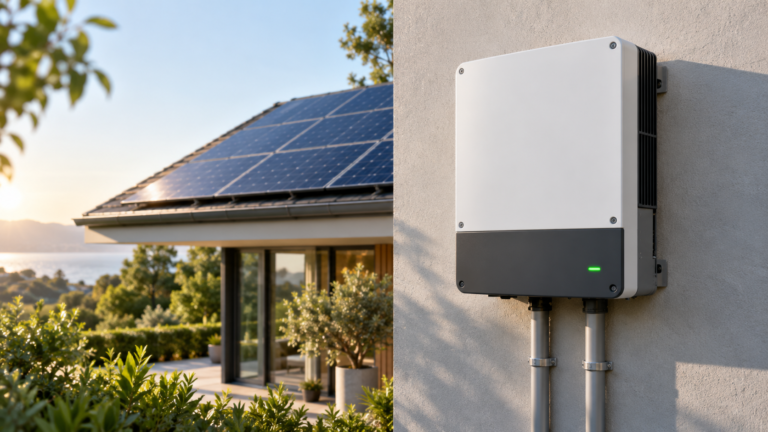

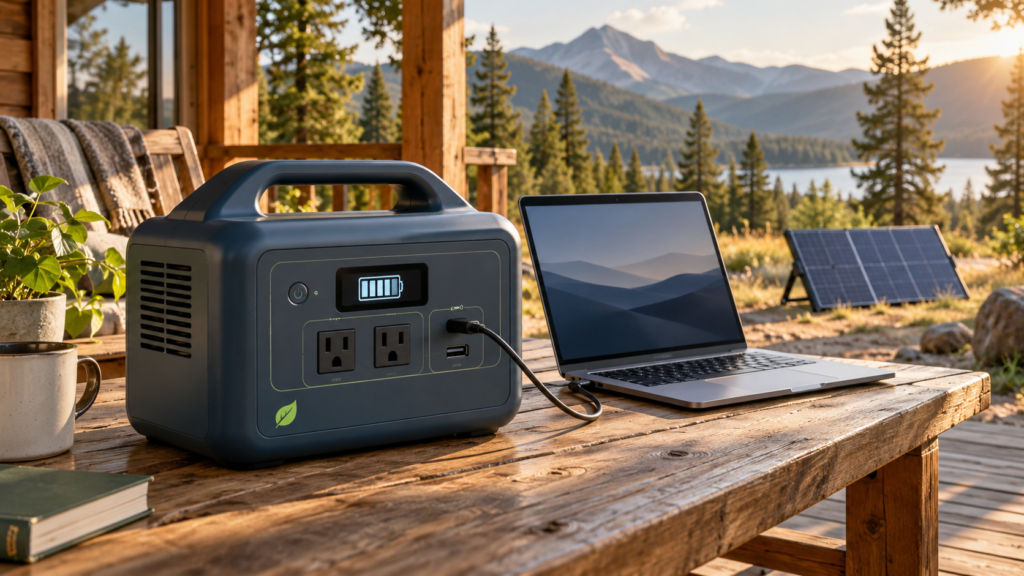
A portable power station is a rechargeable battery system that stores energy and supplies electricity through built-in ports and outlets. It brings together a battery, charging electronics, protective controls, and usually an inverter in one enclosure you can move between locations.
That makes it useful wherever access to an outlet is limited. You might use one to charge a laptop at a campsite, run lights in a cabin, or keep essential devices powered during an outage. Its usefulness depends on what you connect, how long you need power, and how you will recharge it.
The product names and ratings can make this sound more complicated than it is. A power station, a solar generator, and a power bank share some features, but they are not always interchangeable. Understanding a few basic distinctions helps you see what each can actually do.
This guide explains how portable battery power stations work, how to read their ratings, and how to connect those numbers to everyday use. Here, “power station” means the portable battery system, rather than a facility that generates electricity for the grid.
How does a portable power station work?
The process has three stages: charge the unit from a supported source, store energy in the battery, and supply electricity to connected devices. Once that stored energy is used, the station needs recharging.
Those stages happen inside the same enclosure. Looking at the components makes it easier to understand both the convenience and the limits of the system.
What is inside a portable power station?
Each component handles part of the process, so you do not have to assemble a separate battery, charger, and power-delivery system.
| Component | Its job |
|---|---|
| Rechargeable battery | Stores energy for later use |
| Battery management system | Monitors conditions such as battery voltage, current, and temperature and applies protective limits |
| Charging electronics | Manage electricity entering the battery from supported charging sources |
| Inverter, on models with AC outlets | Converts battery electricity into the form required by household AC appliances |
| Output ports and controls | Deliver power to connected devices and let you manage available outputs |
The battery supplies direct current (DC) electricity, which flows in one direction. Household outlets supply alternating current (AC), which reverses direction repeatedly. The inverter handles the conversion when you use the power station’s AC outlets.
USB and other DC outputs use their own regulation or conversion circuitry. Some compact power stations offer only DC outputs, so check the actual ports rather than assuming every model includes household outlets.
How is it different from a battery, power bank, or generator?
Having those components together is what distinguishes a power station from a standalone battery. It also helps explain where power banks and generators fit.
| Product | Main distinction |
|---|---|
| Standalone battery | Stores energy but usually needs additional equipment to provide charging and appliance-ready outputs |
| Power bank | Usually emphasizes small size and USB charging for phones, tablets, and laptops |
| Portable power station | Combines storage and power-delivery equipment, often with more capacity and a wider selection of outputs |
| Fuel generator | Burns fuel to generate electricity while its engine operates |
| Solar generator kit | Usually pairs a portable power station with compatible solar panels |
The boundary between a large power bank and a small power station is not perfectly fixed. Capacity, output ratings, and port selection are more useful than the name on the box.
Likewise, a “solar generator” is generally a description of the combined setup. The panels generate electricity from sunlight. The power station stores energy and supplies your devices.
Do you need solar panels to use one?
The term “solar generator” can make panels sound essential, but a power station can work without them. Solar is simply one possible way to recharge its battery.
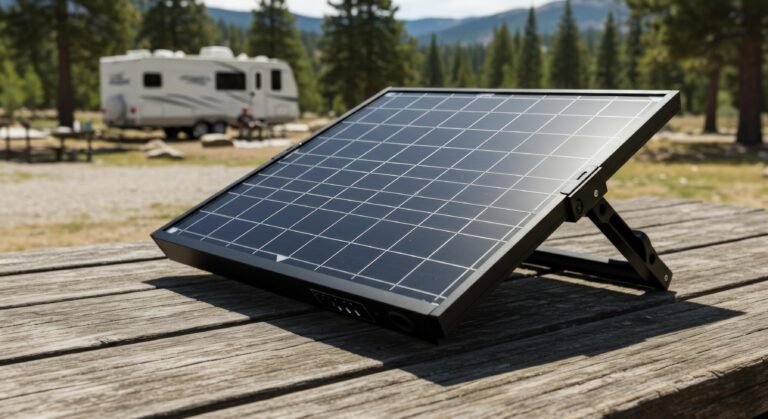
Depending on the model, a power station can charge from a household outlet, compatible solar panels, or a supported vehicle connection. Accessories and charging limits vary. Manufacturer specifications distinguish these charging methods, as shown in EcoFlow’s charging information.
For occasional home backup, you might keep the unit charged from a wall outlet. For camping, solar can help replenish energy when a household outlet is unavailable.
Solar panels must match the power station’s permitted input voltage, current, and connection requirements. A connector that fits does not prove electrical compatibility. Weather, shade, panel positioning, and the station’s input limit also affect charging speed.
Whichever charging source you use, the next question is what the stored energy can do. Two ratings help you answer that.
What do watts and watt-hours tell you?
Watts tell you about power delivery. Watt-hours tell you about stored energy. Together, they help answer two separate questions: can the station run your equipment, and can it run it for long enough?
Watts: what you can run
Watts (W) measure power: how quickly electricity is being delivered or used. A power station’s continuous output rating describes the power it can supply under specified conditions.
Imagine a laptop drawing 60 W, a fan drawing 40 W, and a light drawing 10 W. Together, these assumed loads need 110 W. The power station must support that combined demand through the outputs you are using.
Also check each port’s limit. A high total output rating does not mean every USB port or outlet can deliver that full amount independently.
Some appliances need a brief burst of extra power when starting. This is where surge capability matters. A refrigerator may fit within the continuous rating yet still need more starting power than the station can provide.
Watt-hours: how much energy is stored
Watt-hours (Wh) measure energy. A 500 Wh battery has a nominal stored-energy capacity equivalent to 500 W for one hour, before usable-capacity limits and operating losses are considered.
That does not mean a 500 Wh power station can run a 500 W appliance. Its output rating must also be high enough.
For example, a unit rated at 500 Wh and 300 W continuous stores 500 Wh of energy, but a 500 W appliance exceeds its continuous output capability. Capacity cannot make up for insufficient output power.
What can you power with one?
With those ratings in mind, you can match a station to specific devices. Depending on its capabilities, it may support phones, laptops, lighting, fans, cameras, routers, and some appliances or tools.
Heating and cooking equipment often demand much more power than small electronics. Even when a station can run a kettle or heater, those devices can consume its stored energy quickly.
For each device, check:
- The required outlet or charging connection.
- Running power and any starting surge.
- Required voltage and, for AC equipment, frequency and waveform compatibility.
- How long you need it to operate.
For USB-C charging, check that the port and cable support the device’s required charging profile and power level. Matching the plug shape is only the first step.
How long will a power station last on one charge?
Once you know a station can run your devices, you can estimate how long it will keep them powered. A useful starting calculation is:
Runtime in hours = usable energy in watt-hours ÷ average device power in watts
Suppose a fully charged 500 Wh station delivers 80% of its rated energy to a particular AC load after operating losses. That leaves 400 Wh available. A steady 50 W load would run for approximately eight hours.
The 80% figure is an illustrative assumption, not a universal efficiency rating. Actual runtime depends on the output used, battery condition, temperature, settings, and the station’s own power consumption.
Appliances also behave differently. A refrigerator cycles on and off, while a space heater can draw substantial power continuously. Use average consumption for runtime estimates, but check maximum and starting demand for compatibility.
You do not need a perfect prediction. A realistic estimate with some reserve is more useful than planning around the most optimistic number.
Can a power station provide backup during an outage?
The same power and runtime limits apply during an outage: a station can supply compatible devices while stored energy remains. Backup use adds another question, though. Will it switch automatically when utility power fails?
Some models offer a UPS, or uninterruptible power supply, function. Others offer an emergency backup mode with a different switching delay. Check the specified transfer time and the connected equipment’s requirements. Do not assume every power station will keep every computer or other sensitive device running without interruption.
Running individual plug-in devices is also different from powering household circuits. A compatible home connection requires approved equipment and proper installation. Never feed a power station’s output into an ordinary household wall outlet to energize your home.
What should you check before choosing one?
Whether your goal is camping power or home backup, start with your devices, required runtime, and opportunities to recharge. Use that plan to compare the specifications that affect the job:
- Capacity: enough usable energy for your planned runtime, with reserve.
- Output: sufficient continuous power, surge capability, and suitable ports.
- Charging: supported sources and realistic recharge time between uses.
- Portability: weight and dimensions you can comfortably move.
- Battery longevity: the manufacturer’s stated cycle life and remaining-capacity threshold.
- Operating limits: permitted temperatures, ventilation requirements, and water protection.
A battery cycle-life rating does not mean the unit suddenly stops working after that many cycles. It usually describes how many cycles the battery is expected to complete before reaching a specified remaining capacity under test conditions.
Some stations support extra batteries. These can increase runtime, but adding storage does not necessarily increase output power. For example, EcoFlow lists configurations with different capacities but the same AC output rating.
Common power station questions
Beyond capacity and output, a few everyday details affect where and how you can use the station.
Can you use one indoors?
A battery power station does not burn fuel or produce engine exhaust during normal operation. Use it within the manufacturer’s indoor-use instructions, keep ventilation openings clear, and protect it from water and excessive heat. A fuel generator has different safety requirements and must never operate indoors.
Is a power station silent?
Not necessarily. It has no combustion engine, but cooling fans can become noticeable during charging or heavy use.
Can you use it while it charges?
Many models allow this, but supported outputs and limits vary. Check the manual. If connected devices and operating losses consume more power than the charging source supplies, the battery will still drain.
Is it suitable for long-term off-grid power?
It can be part of the setup, provided its storage, output, and charging capabilities match your daily needs. The key is replacing the energy you use, including losses, while retaining enough reserve for periods when charging is limited.
Bringing it all together
A portable power station gives you a convenient way to store energy and use it where you need it. The right fit starts with your devices: enough output to run them, enough usable capacity to last, and a practical way to recharge. Once those pieces line up, the specifications become much easier to interpret. You can focus on the power you actually need, whether that is a charged laptop at camp or a few essential devices during an outage.